Selecting the right interior window treatments involves balancing architectural design with long term physical performance. In Australia, where internal environments must withstand high coastal humidity, intense solar radiation, and fluctuating seasonal temperatures, this choice becomes even more critical. Plantation shutters remain a premier choice for both high-end residential and commercial projects. However, the market divides sharply across three primary materials: premium timber, polyvinyl chloride (PVC), and eco-friendly polymer composites.
Choosing between these materials requires looking past surface aesthetics. Each material reacts differently to moisture, displays unique thermal properties, and carries a distinct environmental footprint. This guide provides a direct performance analysis to help you specify the correct shutter material for every room in an Australian property.
Moisture Resistance: The Wet Area Showdown
High moisture environments like bathrooms, laundries, and kitchens present a major challenge for window coverings. Internal steam, condensation against cold glass, and occasional direct water splashes require materials that do not absorb water.
Performance in Bathrooms and Laundries
Natural wood contains organic cell structures that expand when absorbing moisture and contract as they dry. In an Australian bathroom or laundry, this continuous cycle leads to structural failure over time. Even when coated with premium polyurethane paints, timber shutters exposed to persistent steam will eventually suffer from moisture ingress. This causes the wood grain to swell, resulting in hairline cracks in the paint layer. Once the paint film cracks, water penetrates deeper, causing the timber to warp, twist, and rot, while the coating bubbles and peels. Consequently, timber is unsuitable for wet areas.
PVC shutters provide complete water resistance. Manufactured from synthetic polymers, these shutters contain no organic fibres. They cannot absorb moisture, swell, or warp, regardless of the humidity level. High-quality PVC formulations use water-based, oven-baked topcoats that bond chemically to the substrate. This ensures the finish will not chip, flake, or peel in steam-heavy environments.
Eco-friendly composite shutters, typically constructed from a blend of recycled polymers and wood by-products or advanced non-toxic foamed PVC, deliver identical moisture protection. The extrusion process wraps or seals any fibrous content in a synthetic matrix, preventing water molecules from penetrating the core.
Living Rooms and Dry Zones
In open-plan living areas, dining rooms, and bedrooms, the moisture dynamic changes. While these spaces do not experience localised steam, they are susceptible to seasonal humidity fluctuations. Timber shutters perform exceptionally well in these dry zones.
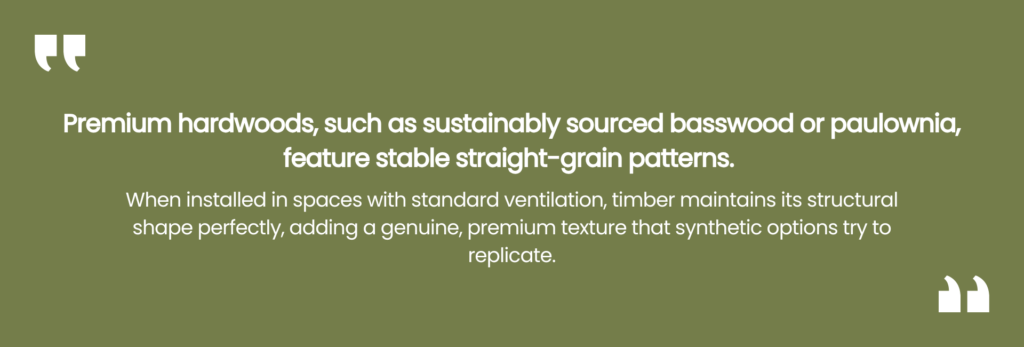
Premium hardwoods, such as sustainably sourced basswood or paulownia, feature stable straight-grain patterns. When installed in spaces with standard ventilation, timber maintains its structural shape perfectly, adding a genuine, premium texture that synthetic options try to replicate.
Thermal Insulation and Energy Efficiency
Window openings account for up to 40% of a home’s heating energy loss and up to 87% of its summer heat gain. Shutters act as a secondary thermal barrier over the glazing, directly affecting the property’s overall energy efficiency and compliance with modern Australian building standards.
Understanding Material R-Values
The thermal performance of a window treatment is measured by its R-value, which represents its resistance to heat flow. A higher R-value indicates superior insulating capability.
- Premium Timber: Wood is a natural insulator because millions of microscopic air pockets are trapped within its cellular structure. Solid timber shutters restrict conductive heat transfer, keeping winter warmth inside and summer heat outside. Timber louvres maintain a uniform thermal barrier across the window opening.
- PVC Shutters: Solid PVC has reasonable thermal resistance, but it conducts heat faster than natural timber. To solve this, high-quality PVC shutters feature a hollow core or a foamed internal structure. However, because PVC expands and contracts significantly when exposed to direct Australian sunlight, these shutters require internal aluminium reinforcement rails running through the louvres and stiles. This metal core increases structural stability but slightly lowers the overall thermal resistance by creating minor thermal bridges.
- Eco-Friendly Composites: Engineered composite shutters often deliver the highest thermal insulation values. Many utilise a dense, foamed cellular composite structure that mimics the density of timber without the thermal bridging of heavy metal cores. These composites create a highly restrictive pathway for heat, outperforming standard PVC in reducing solar heat gain during hot summer afternoons.
Performance Across Australian Climate Zones
In southern regions like Melbourne, Hobart, and the alpine areas, the primary goal is retaining heat during winter. Tight-closing timber or dense composite shutters form an insulating air pocket against the glass, slowing down convective currents that pull heat from the room.
In tropical and subtropical zones, such as Brisbane, Darwin, and Sydney, the priority shifts to blocking solar radiation. Here, composite and treated timber shutters block radiant heat before it warms the interior air, reducing the load on air conditioning systems.
Environmental Impact and Carbon Footprint
Specifying materials in the current building landscape requires looking closely at product lifecycles, manufacturing energy, and end-of-life disposal options.
Premium Timber Lifecycles
Sustainably harvested timber carries a very low carbon footprint. Responsible manufacturers source wood certified by bodies like the Forest Stewardship Council (FSC) or the Programme for the Endorsement of Forest Certification (PEFC). Trees absorb carbon dioxide during growth, locking it into the material. The energy required to mill, kiln-dry, and shape timber shutters is significantly lower than the energy needed to synthesise plastics or smelt metals. At the end of its useful life, untreated or water-finish timber is naturally biodegradable.
MATERIAL LIFECYCLE COMPARISON
| Material | Carbon Footprint | End-of-Life / Recycling |
|---|---|---|
| Premium Timber | Low (Carbon Sink) | Biodegradable / Compostable |
| Standard PVC | High (Fossil Fuel Base) | Difficult / Landfill-Bound |
| Eco-Friendly Composite | Moderate (Recycled Base) | Often Recyclable |
The Realities of PVC Manufacturing
Standard PVC production relies heavily on petrochemicals and energy-intensive chlorine extraction. The manufacturing process releases greenhouse gases and requires stabilisers, often historically involving heavy metals, to prevent the plastic from degrading under UV light.
While modern Australian PVC shutters use safer, non-toxic, lead-free stabilisers, the material remains derived from fossil fuels. Furthermore, standard PVC shutters reinforced with internal aluminium are very difficult to recycle because separating the metal core from the plastic outer skin is a complex process. Most end up in landfill, where they take centuries to decompose.
Eco-Friendly Composite Innovations
Eco-friendly composites balance performance with environmental responsibility by utilising recycled polymers or integrating clean, closed-loop manufacturing systems. These products avoid plant-harming harvesting practices while diverting industrial plastic waste from landfills. They require more processing energy than pure timber but achieve a much longer operational lifespan than low-grade plastics, reducing the need for frequent replacements.
Structural Integrity, Weight, and Engineering Spans
The physical weight and strength of a material dictate the architectural configurations available for a project. Large windows, bi-fold patio doors, and wide multi-panel openings require careful material engineering for custom indoor shutters.
Weight Distribution and Panel Sagging
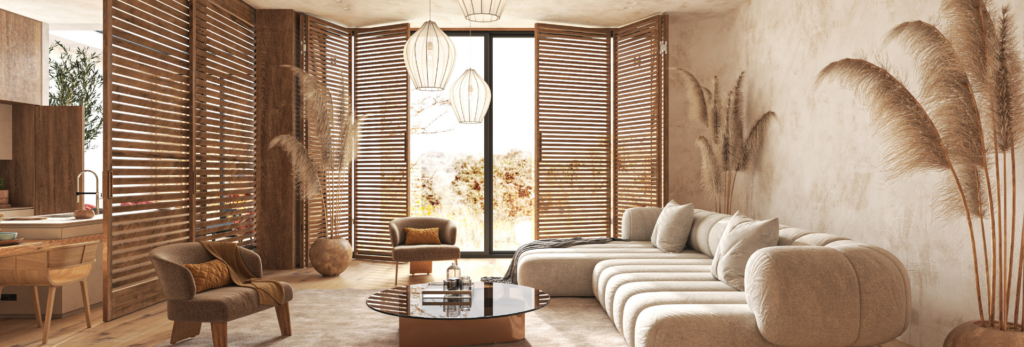
Timber possesses an excellent strength-to-weight ratio. Hardwoods like paulownia are remarkably lightweight yet structurally rigid. This low mass prevents shutter panels from sagging on their hinges over time. Because of this inherent strength, timber panels can span up to 950mm to 1000mm in width a single panel without requiring intermediate T-bars or vertical support. This allows for cleaner, uninterrupted views through wide windowpanes.
PVC is a dense, heavy material. A standard PVC shutter panel weighs up to double the weight of an identical timber panel. This mass puts constant leverage on the hinges and window frames. Without internal support, wide PVC panels will sag, causing the bottom edge to catch on the shutter frame during operation. To prevent this, PVC manufacturers limit the maximum single-panel width to approximately 750mm. For wide window spans, you must specify more panels, which introduces more vertical lines and reduces the open view.
Advanced composites fall in the middle. Their structural limits depend on whether the formulation uses internal reinforcement. High-grade engineered composites can safely achieve spans of up to 900mm, offering a viable alternative to timber for large window installations.
Maintenance and Long-Term Durability
The UV index in Australia can degrade interior finishes quickly. Daily exposure to direct sunlight through double-glazed windows can raise surface temperatures on shutters to over 60 degrees Celsius.
MAINTENANCE & DURABILITY MATRIX
| Material | Cleaning Protocol | 10-Year UV Outlook |
|---|---|---|
| Premium Timber | Dry dust, specialised oils, avoid excessive water | May require repainting or tightening due to movement |
| PVC Plantation | Damp cloth, mild detergents, fully waterproof | High stability, yellow-proof if UV-stabilised |
| Eco-Friendly Composite | Damp cloth, minimal care, scratch-resistant | Excellent resistance to fading and thermal distortion |
UV Exposure and Colour Fastness
Inferior PVC and plastics turn yellow and brittle under harsh UV rays due to polymer degradation. However, premium PVC plantation shutters formulated for Australian conditions include titanium dioxide blockers that deflect UV radiation, preserving the clean white finish for decades.
Timber resists UV degradation structurally but relies entirely on its painted or stained finish. Direct sunlight will eventually fade natural wood stains and can yellow oil-based paints. Choosing water-based UV-rated acrylic topcoats protects timber from premature fading.
Cleaning Protocols
PVC and composite shutters are exceptionally easy to maintain. Their hard, non-porous surfaces allow you to wash away dust, grease, and grime with a damp microfiber cloth and mild dishwashing liquid. You can clean them thoroughly without worrying about damaging the material.
Timber requires a gentler approach. You should regularly dust timber shutters or wipe them with a well-wrung, slightly damp cloth. Avoid harsh chemical cleaners, abrasives, or excessive water, as these can strip the protective finish or soak into the wood grain, causing permanent structural damage.
The Allegra Difference: Spaces Made to Last
Choosing the right shutter material is only half the equation; precision engineering and honest guidance complete it. At Allegra Interiors, we design, supply, and install custom window furnishings, featuring industry-leading Norman Shutters, alongside tailored upholstery and wallcoverings for commercial and residential projects nationwide. Our philosophy is simple: we listen, understand, and provide honest guidance to help you choose what is genuinely right for your lifestyle, space, and budget. We never simply push the most or least expensive option.
With our coordinated, end-to-end service, we deliver exceptional value on time and on budget, ensuring your investment is beautiful, functional, and built to withstand the unique Australian climate. We don’t just dress rooms; we create intentional, personal spaces that are made to last.
Book your custom design consultation with the Allegra Interiors team today. Based in Melbourne, we work Brisbane, Sydney and cities Australia-wide.
FAQs
How do composite shutters compare to timber in thermal insulation?
Advanced eco-friendly composites often deliver higher thermal resistance than PVC and match timber by utilising dense, foamed cellular structures. They trap air efficiently, blocking radiant heat in summer and retaining warmth in winter. Allegra Interiors provides high-performance composite solutions for residential and commercial projects. Book an expert consultation today to boost your home’s energy efficiency.
What is the environmental footprint of premium timber shutters?
Sustainably sourced timber carries a very low carbon footprint because trees naturally sequester carbon. Look for FSC or PEFC certifications to ensure responsible forestry. At Allegra Interiors, we specialise in supplying eco-conscious, high-quality window treatments for sustainable commercial and residential projects across Australia. Book a consultation with us today to explore our timber and eco-friendly indoor shutters.
Can I mix different shutter materials within the same property?
Absolutely, and we highly recommend it. Specifying waterproof PVC for wet areas and lightweight, wide-span timber for living zones maximises both performance and aesthetics. Allegra Interiors seamlessly matches finishes across different materials for residential and commercial projects Australia-wide. Book a design consultation today to create your cohesive whole-house window plan.
How do custom shutters improve a building’s NatHERS rating?
High-quality shutters act as an extra insulating layer over your glazing, significantly lowering convective heat transfer and reducing the building’s heating and cooling loads. Allegra Interiors assists commercial developers and homeowners in meeting strict modern efficiency standards nationwide. Schedule a specialised consultation today to optimise your build.
Can you install shutters on unusual window shapes like arches or circles?
Yes, bespoke plantation shutters are the ideal solution for architectural oddities. Crafting shutters for arched, raked, or circular frames requires expert measuring to ensure a perfect fit and smooth operation. Allegra Interiors specialises in custom, precision-fit shutter solutions for any window shape, residential or commercial. Book your design consultation today to discuss your unique project requirements.